

Time for the Danse Macabre as we explore the origins of the Eldar Harlequins
These dancing, mysterious warriors who combine art and war leapt into the game from the pages of White Dwarf 105 onwards!

I’ve always had a soft-spot for the Eldar in Warhammer 40,000. Initially limited to mostly being pirates and/or mercenaries (with the occasional half-Eldar Ultramarine, Illiyan Nastase) they had a sense of the enigmatic about them from the start, echoing the role of elves in other fantasy settings and indeed in folklore. Then, introduced in White Dwarf (WD) issue 105 and followed up over the next couple of issues, a new sub-faction would launch; the Eldar Harlequins.
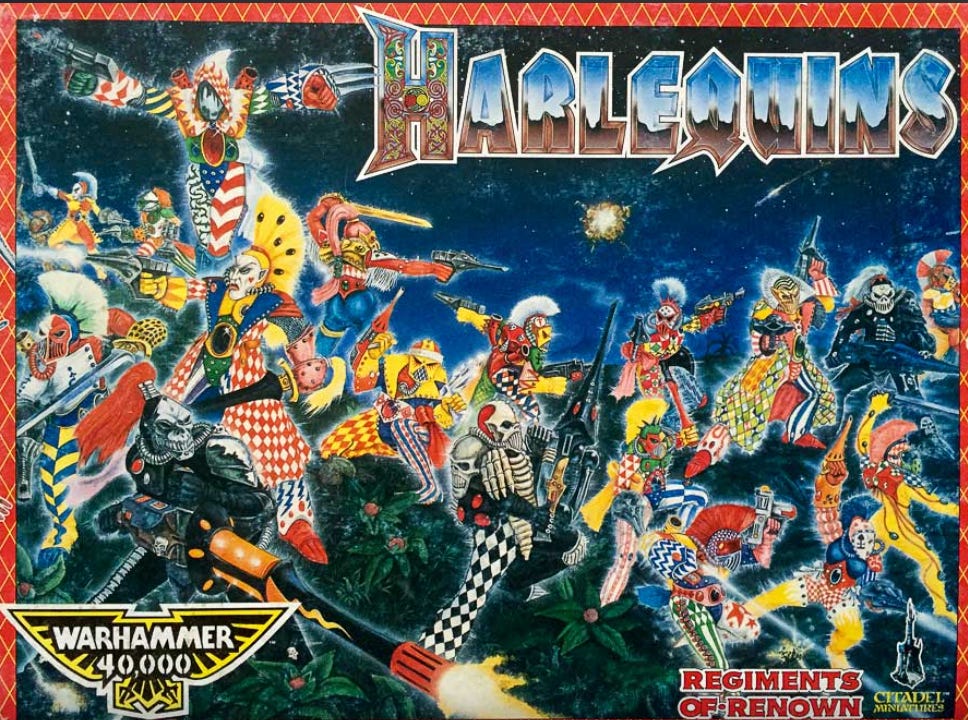
(Image - The front of the boxed set of Eldar Harlequins, coded RTB6 and as a ‘Regiment of Renown’. It shows a warband of brightly-colored Eldar warriors in action. The faction still exists today in the current game.)
With their introduction, a new layer of lore would expand though the overall faction, deepening lore of the Warhammer 40,000 setting in the process. At the start, in Rogue Trader, the Eldar lore had Craftworlds, Warp-Gates and it was common for them to be psychic. They also had ‘intra-vision’ so were able to see in the dark. There were no Drukhari back then (though Citadel had produced one ‘Dark Elf Space Trooper’ back in march ‘87) and the text suggested that the Eldar that left the Craftworlds to become pirates, mercenaries, bounty hunters and adventurers were those either unhappy with the more sedate life the floating worlds offered, or had been banished from Eldar society for disturbing behaviour.
Post the release of Rogue Trader, the Eldar got a regular tick-though of new units - Dreadnoughts, the War Walkers, heavy weapons units - and then a small lore update in WD 101, which added the idea that Eldar souls could be ‘kept’ by their technology.
1988’s Book of the Astronomican added a character - Lord Prince Yriel, leader of the Eldritch Raiders pirate forces. As human mercenary force players could add Eldar to this grouping, adding Eldar Impressors and Void-Dreamers (both psychic units), Eldar Exigators and Protectors, Lightning and Thunder Squads, Eldar Dreadnoughts, Grav-Attack Vehicles (but no image of them). As Eldar Pirate forces, players could add Shadowlords, Malefactors, Prefectors, Probati, Serpent and Dragon Squads and Zoat Terror Squads. This was because Eldar Pirates back then preferred to use Zoats, abandoned by Hive-Fleets, as auxiliary mercenaries. For vehicles it was Eldar Dreadnoughts, Grav-Attack Vehicles and stolen Imperial Speeders.
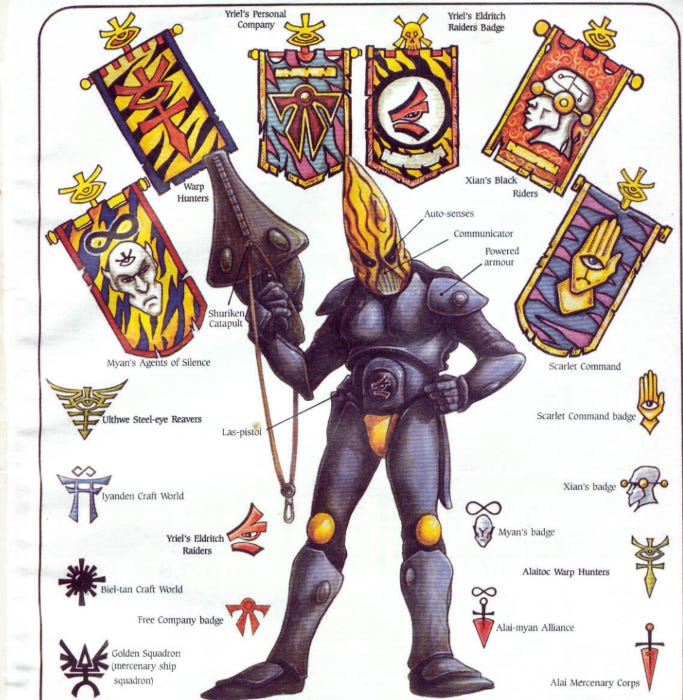
(An Eldar warrior of Yriel’s Eldritch Raiders. The warrior stands with a weapon in one hand surrounded by the insignia and heraldry of the unit. Source - Book of the Astronomican)
Then in WD 105 the lore expanded with the idea of a troupe of dancers/warriors who traveled between Craftworlds intent on reminding them of the fall to Chaos. Now the Eldar were not just enigmatic, but were also tragic and ethereal too. Here’s a draft section from the timeline of the book covering some of 1988 from when they launched:
September 1988 - WD 105 is an important issue as it gives us the iconic tank of the Land Raider, it gives us the first Space Marines Army List, Codex Imperialis in Index Astartes and an introduction to the sub-faction to the Eldar, the Harlequins, who would also take the cover of this issue.
October 1988 - We are a year on from the release of 40K Rogue Trader and WD 106 goes all in on more 40K with artillery rules and the Eldar Harlequins army list as the boxed set launches. This author purchased the set, painted them and won many, many games with them.
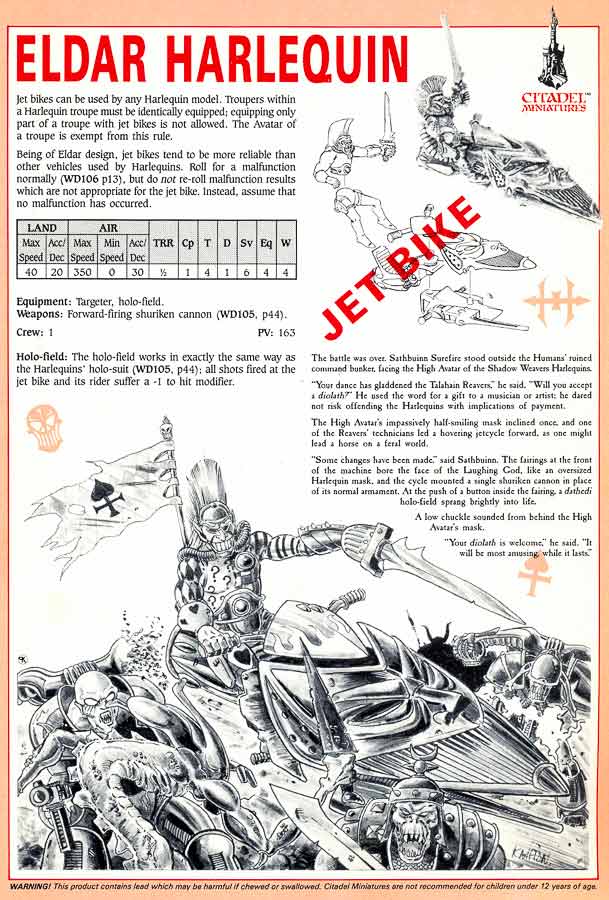
November 1988 - WD 107 would see the release of the Eldar Harlequin Jetbike and, importantly, a preview of the ‘Realm of Chaos: The Lost and the Damned’ via the ‘Chaos Renegade Army List’.
In creating the Eldar Harlequins, GW’s creators were drawing on a deep well of topos. (Topos are the concept of a recurrent idea/common cultural theme with meaning that exists external to the work in question.) This is again from some draft text of how they connect:
Let us take a quick concept - the Jester or the Fool. A slapstick and comedic character with versions that exist in many cultures. Yet for all the comedy they are often portrayed with either a darker, tragic or even brutally honest aspect that exists in contrast to the comedy, as with the Fool in Shakespere’s King Lear. This becomes a topos, a concept with cultural weight. Aspects of it get pulled into the creation of another character topos, the Harlequin. Created around the late 16th century as part of the Italian commedia dell’arte, this checkered patterned costumed tricker plays a more nimble and clever role than the Fool, but draws in aspects. Other creators draw from this topos, for example Agatha Christie’s Mr Harley Quin, who is written into being in 1930. In 1988 a sub-faction to the Eldar is added, the Harlequins, whose role is both the agile, ethereal warrior in battle and who dances the tragic tale of the Eldar at court.
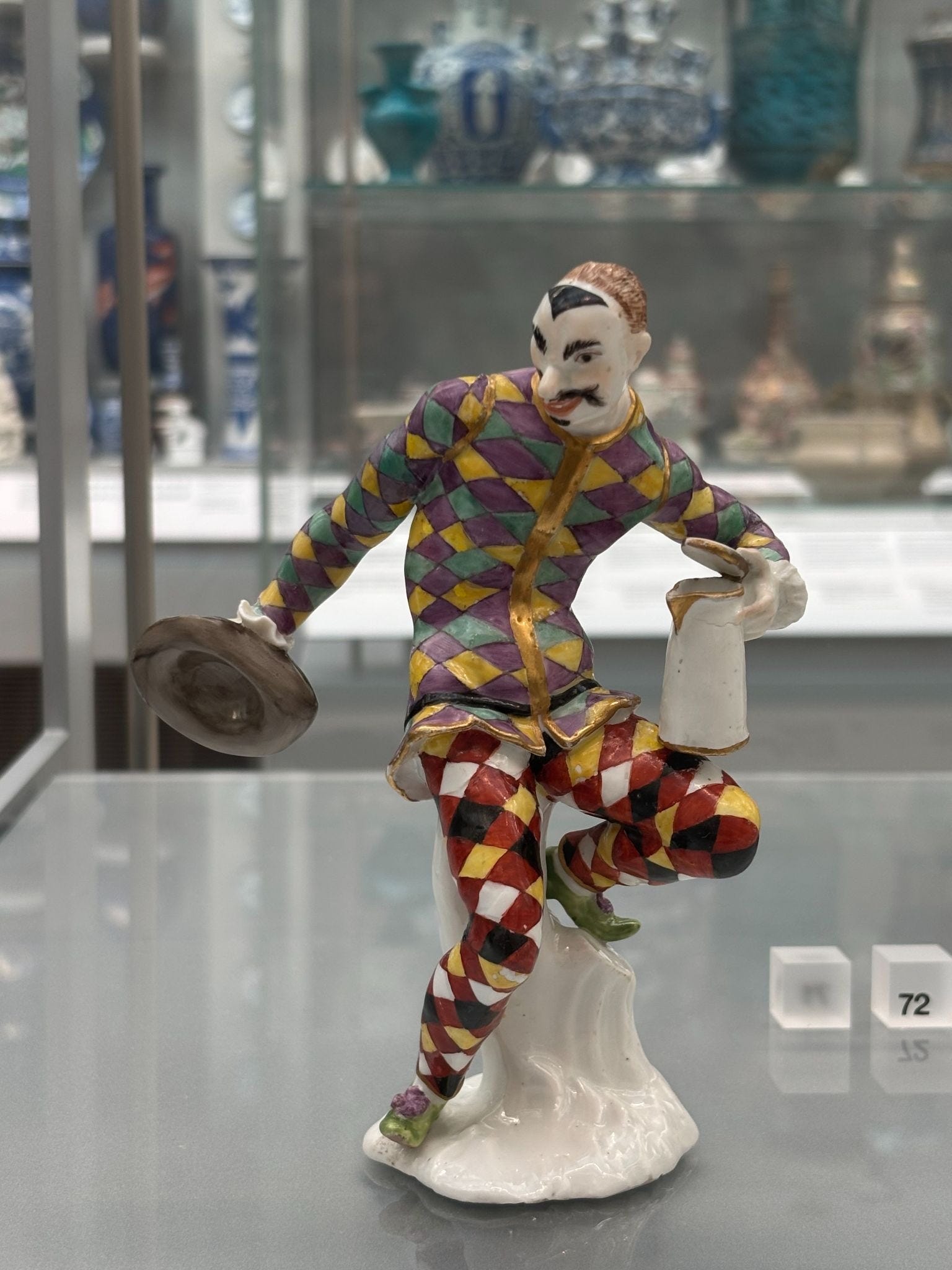
(Image - A porcelain Harlequin by Johann Joachim Kändler, from around 1738. From the Victoria and Albert Museum, London. Photo by author.)
These releases, as well as the RTB6 boxed set, included the blister packs of 4305/6 Harlequins and the 4306 Harlequin Jet Bike. For vehicles, WD 106 would show the Harlequins using an eldar dreadnought and a captured Land Raider.
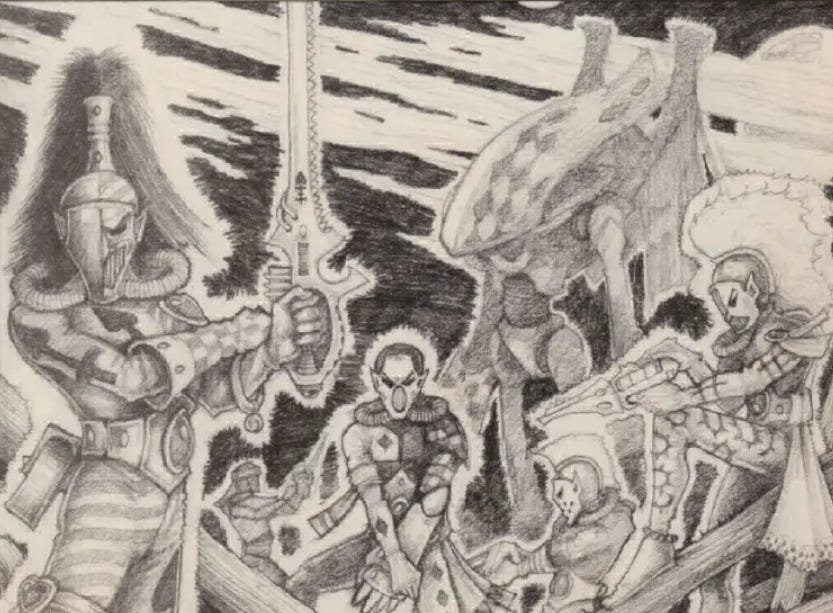
(Image - A group of Harlequin warriors standing in front of an Eldar Harlequin dreadnought with a patterned paint job that matches the warriors. Image from Page 12 WD 106)
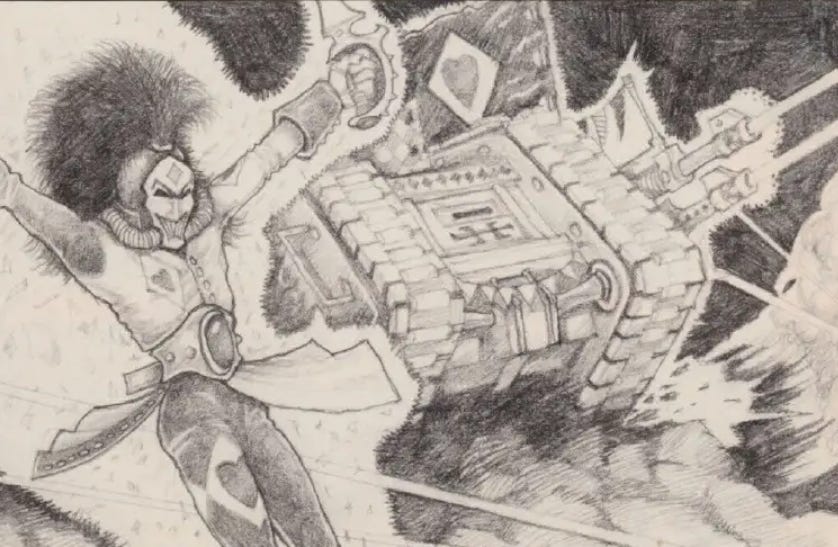
(Image - A Harlequin warrior leaps forward ahead of a captured Imperial Land Raider adored with Harlequin flags. Image from Page 18 WD 106)
Jordan Sorcery has a good video on the Harlequins too!
Thanks for reading!
Links of Note:
The Eldar now: Warhammer 40,000 Faction Focus: Aeldari (inc. Harlequins)
Grab this Warhammer 40,000 Boltgun 2 desktop back ground art for free!
That one Time Games Workshop was a Video Game Publisher - Codex Compliant
Note! There is more about this project here. The direct chat for this project is here. You can comment here or find me on BlueSky.
Also note! This book project is a personal one and not affiliated with any company that, in my day job, I work with or partner with.
One thing that could be pointed out is that the Harlequin maschera (even in its face mask shape) has solid roots in a mix of "pagan", demonic, psychopompous folklore, with the devil Helleking/Herlequin ("Hölle Kõnig", King of Hell) - also Alichino in Dante Alighieri's Commedia - being associated with a type of Wild Hunt that somehow mixes the Samhain traditions and the Norse Mythology, in a typical Christian re-interpretation. You first had the goddess Hel guiding the ride of her maidens, the Herlequins, and even, later, Odin/Wotan/Woden himself riding in front of the Valkiryes, getting then somehow con-fused with the cited demon king of Hell and the English mythical king Herla Cyning. It's all a bit more complicated than this, but fascinating. And the link to the otherworld, death, the Wild Hunt, the Fey spirits... it all goes a long way in the right direction, to my eyes, also taking in account that the Eldar Harlequins were developed in parallel to the (Warhammer Fantasy) Wood Elves Wardancers, who greatly sport such suggestions.
Also, I'd note that the link between our Samhain and the Eldar is notably expressed through the Saim-Hann Craftworld and its "Wild Riders".