

Conan The Barbarian, Warhammer and the Birth of the Fantasy Genre
What is a war-hammer good for? Crushing your enemies, seeing them driven before you and hearing the connection to Games Workshop

A slightly different post this time as I was honored to join the Retro Ramble podcast to talk about Conan the Barbarian (Apple Podcast/Patreon/YouTube/Spotify) as part of a look back at the 1982 film of the same name. Why was I asked? Well, as part of the research into how Warhammer came to be, I did touch on Conan somewhat. So here I’m going to explain the connection from Conan to Warhammer 40,000. Then I’ll give a few notes on how Conan came to be, how the original Conan stories connect to the 1982 film (see part 2 post!) and a few other interesting bits. First off here’s the trailer to the 1982 film:
The Birth of Sword & Sorcery
Why Conan? So working backward: Without Warhammer Fantasy Battle, there’s no Warhammer 40,000. Without Dungeons & Dragons, there’s probably no Warhammer Fantasy Battle. Without Conan there is no D&D. (At least not in the way we know it)
When D&D was being formed, its creators were inspired by a bunch of other games and fiction writers, which the co-creator Gary Gygax documented in an essay called Appendix N. So as part of my work, I put a couple of the key names here into a timeline of 40K, which is a major section of the book.
Here’s a draft excerpt from that timeline:
1929 - Pulp author, Robert E Howard, has his story ‘The Shadow Kingdom’ featuring the proto-Conan the Barbarian character, Kull of Atlantis, published in Weird Tales. This is a genre we’d now recognise as ‘Fantasy’.
1932 - Another Robert E Howard story appears, ‘The Phoenix on the Sword’ is published in the December issue of Weird Tales. This would be the first published work featuring the character ‘Conan the Barbarian’ As with the Kull stories, it would feature fantastical elements of monsters, warriors, adventure and magic set in a fantasy age undreamed of. It is argued by Toogood (2020:8) to have been the birth of the ‘Sword of Sorcery’ genre, “In a brief flourish of creativity Howard single-handedly created an entire sub genre of literature now known as Sword & Sorcery. He invested it with all its tropes and conventions, and dressed it with haunted cities plucked from the pages of H Rider Haggard, monsters conscripted from the mind of HP Lovecraft and gossamer clad dancing girls summoned from the frustrated well of his own id.” Howard’s Conan works were also referenced in ‘Appendix N’.
1937 - The Hobbit, or There and Back Again, by J. R. R. Tolkien, is published. This book is a foundational inspiration for both the setting (mediaeval fantasy) and structure (a party going on a quest for loot) of what will become the classic RPG format in a few decades time.
So Robert E Howard’s take on ‘fantasy’ pre-dates Tolkien’s by around 8 years, though both are key in this story in creating what we understand as the ‘fantasy’ genre.
Conan & Dungeons & Dragons
As well as getting a shout-out in Appendix N, Conan as well as a bunch of other characters from Howard’s Hyborian Age setting get stat-ed up in D&D’s 1976 supplement ‘Gods, Demi-Gods & Heroes’. Then after the success of the 1982 film, TSR produced two tie-in modules for D&D released in 1984 and followed with a standalone game in 1985.
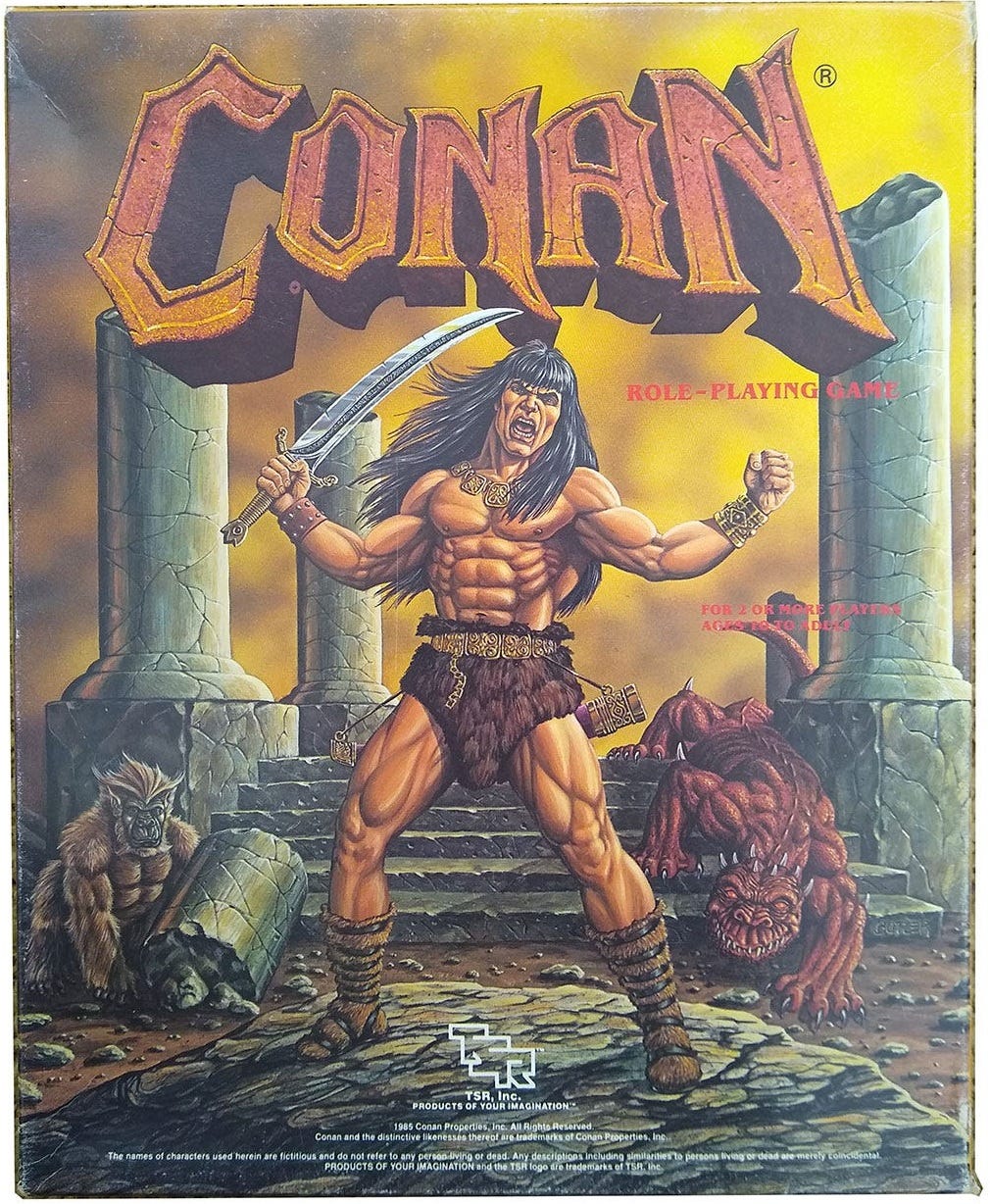
(Image - The cover of the TSR Conan RPG showing Conan with a sword issuing a battle cry in front of a ruined temple and with monsters on either side of him. Source - RediscoveredRealms.com)
Conan & Games & Workshops
Games Workshop, as the UK licenced distributor for TSR, would have sold these games on. Robert E Howard’s stories also were an inspiration for some of the designers and creators there. Bryan Ansell, co-founder of Citadel Miniatures and boss of GW during the Warhammer 40,000 Rogue Traders years, cited Conan in the creation of the Chaos god Khorne:
Khorne was derived from Conan’s “Crom”, who is an “actual” Celtic god who can also be spelt Krom or Khram. Good name for a war god.
Noted designer and creator of Bloodbowl, Jervis Johnson, was also a fan:
I used to play a number of fantasy games, I was into Conan a lot, I liked the Conan comic, sci-fi films, Doctor Who and all the rest of it and effectively the two hobbies combined.
They also jumped onto a zeitgeist of the character by commissioning a parody barbarian, Thrud the Barbarian as a regular comic strip in White Dwarf. Another part of Games Workshop’s business, Citadel Miniatures, also joined the fun with ‘Nigel’ the Barbarian and his fellow barbarians in 1986.
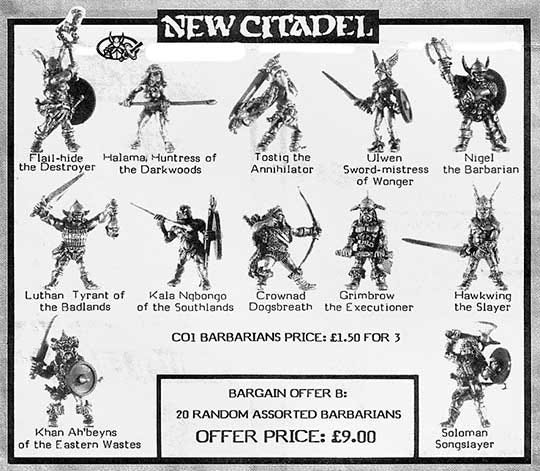
(Image - C01 Barbarians, with Nigel being top-right. Three rows of Barbarian warriors in various poses. Source - Stuff of Legends)
Not to mention the classic GW/MB Games collaboration HeroQuest with its Conan-esque cover star, with the art by Les Edwards. HeroQuest is a fascinating topic of its own.
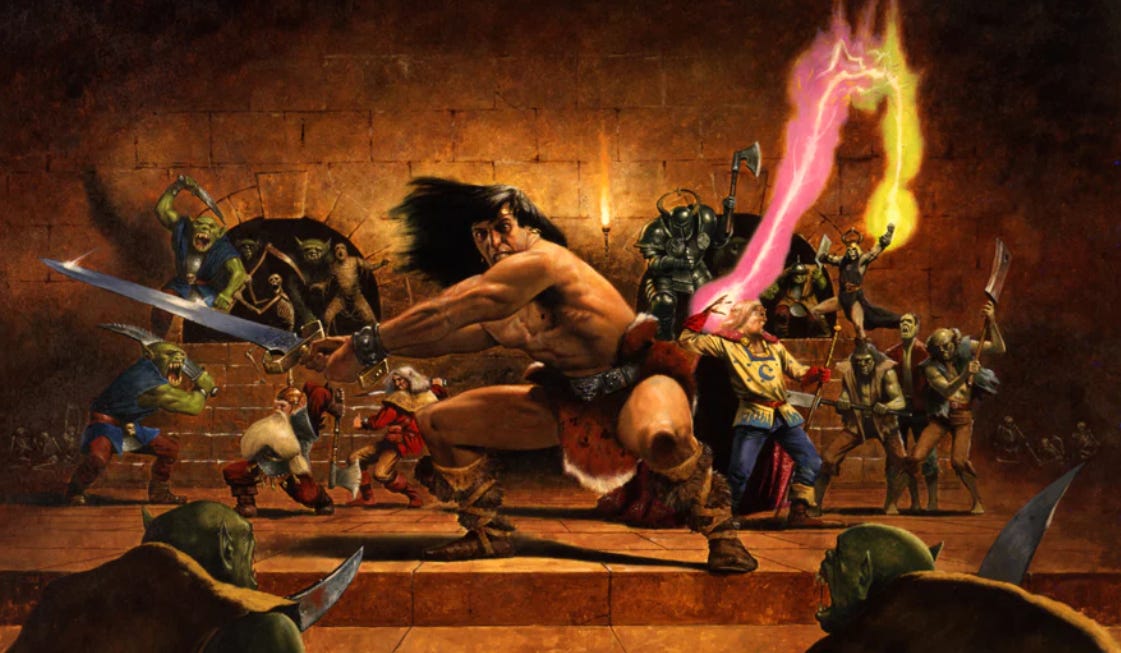
(Image - The cover of HeroQuest showing a party of adventurers with a muscled barbarian warrior in the foreground, hefting a sword to attack his foes. Source lesedwards.com)
Conan as a Character
Conan is an anti-hero and the film captures this to an extent. In the original stories - he does some ‘good’ honorable things but also robs, kills and steals. In the stories he’s a thief, a pirate, a mercenary and a king. The constant theme is about Conan as the representative of the wild, a barbarian, even when a king - and civilization. E.g from Beyond the Black River
“The Cimmerian might have spent years among the great cities of the world; he might have walked with the rulers of civilization; he might even achieve his wild whim some day and rule as king of a civilized nation; stranger things had happened. But he was no less a barbarian. He was concerned only with the naked fundamentals of life. The warm intimacies of small, kindly things, the sentiments and delicious trivialities that make up so much of civilized men’s lives were meaningless to him. A wolf was no less a wolf because a whim of chance caused him to run with the watch-dogs. Bloodshed and violence and savagery were the natural elements of the life Conan knew…”
Conan appears in the pulp fiction of the late 20s onwards. The pulps birthed many notable writers including H.P.Lovecraft (writer of The Call of Cthulhu), Robert Bloch (Psycho), Ray Bradbury (Fahrenheit 541), Robert A. Heinlein (Starship Troopers) and I’ll mention C.L.Moore as she wrote another sword and sorcery character, Jirel of Joiry.
Like fellow pulp writer Lovecraft, was a ‘writer of his time’ in terms of depictions of race, gender and more. But he also does some odd mashups like the ‘Picts’ who are kind of an mashup of the Northern European actual picts and 1930s caricatures/stereotypes of Native Americans. (If you want to go deeper into the pulp themes covered in this paragraph, I’d recommend here)
Robert E Howard wrote stories with generally good plots, interesting world-building (including what we’d now call a ‘cinematic universe’ as his different characters inhabited the same world) and he excelled at combat (from The Phoenix and the Sword).
“With his back to the wall he faced the closing ring for a flashing instant, then leaped into the thick of them. He was no defensive fighter; even in the teeth of overwhelming odds he always carried the war to the enemy. Any other man would have already died there, and Conan himself did not hope to survive, but he did ferociously wish to inflict as much damage as he could before he fell. His barbaric soul was ablaze, and the chants of old heroes were singing in his ears.
As he sprang from the wall his ax dropped an outlaw with a severed shoulder, and the terrible back-hand return crushed the skull of another. Swords whined venomously about him, but death passed him by breathless margins. The Cimmerian moved in, a blur of blinding speed. He was like a tiger among baboons as he leaped, side-stepped and spun, offering an ever-moving target, while his ax wove a shining wheel of death about him.”
Nb. A funny bit in The Phoenix and the Sword is where Conan ponders taxation policy as king. Conan is depicted as lowering taxes on the common people and reigning in the excesses of the aristocracy, who often abused the tax system. A very modern take on a world undreamed of!
How Conan’s Image Developed
Here is a depiction of Conan as a young man from Tower of the Elephant:
“He saw a tall, strongly made youth standing beside him. This person was as much out of place in that den as a gray wolf among mangy rats of the gutters. His cheap tunic could not conceal the hard, rangy lines of his powerful frame, the broad heavy shoulders, the massive chest, lean waist and heavy arms. His skin was brown from outland suns, his eyes blue and smoldering; a shock of tousled black hair crowned his broad forehead. From his girdle hung a sword in a worn leather scabbard.”
This is his first ever depiction from his first published story and he quite a ‘Roman/Ancient Greek’ statue looking imho. The first artist to create an image of Conan was Jayem Wilcox (1895 – 1958).
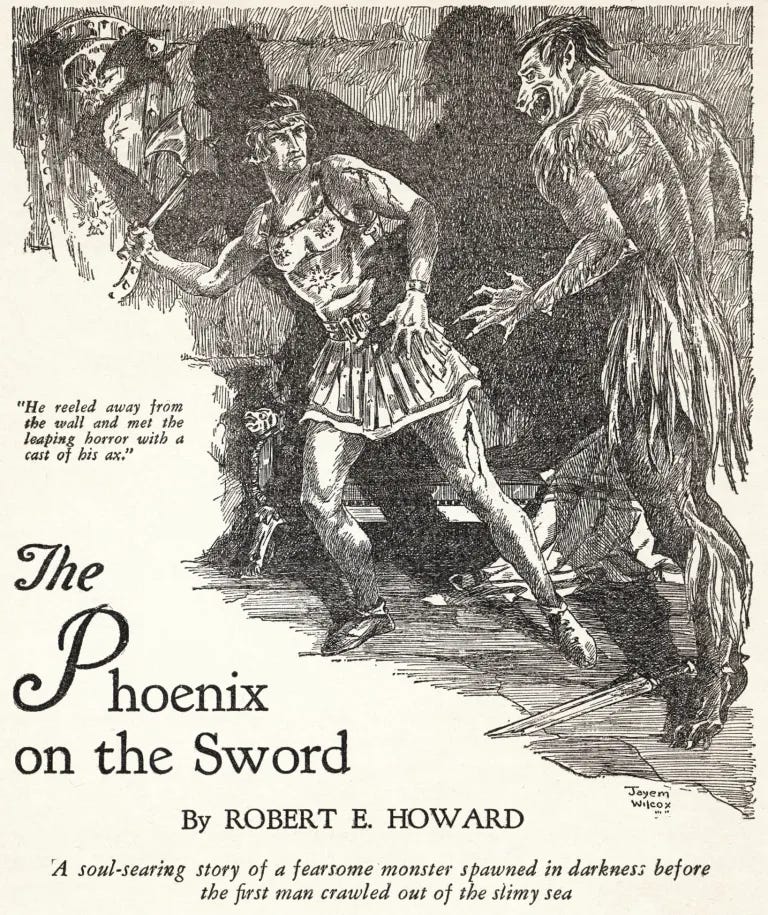
(Image - Conan facing a beast-man monster. Illustration by Jayem Wilcox from Weird Tales. The first published image of Conan)
Margaret Brundage (1900-1976) was the first artist to render Conan stories in color. Here is an example of her work depicting Conan:
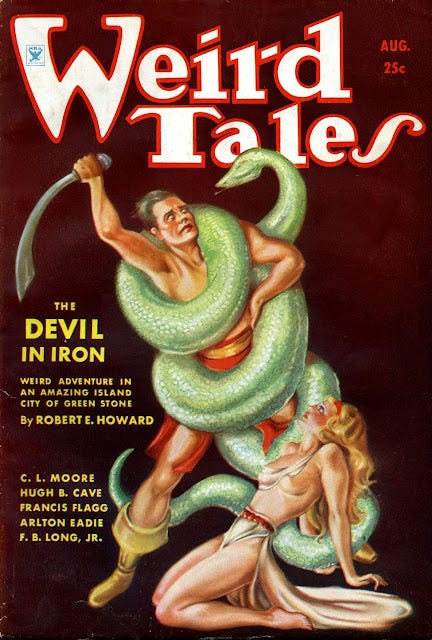
(Image - Conan from Weird Tales, August 1934 depicting him battling a giant serpent.)
But it is really Frank Frazetta who cements his image in the popular imagination and he depicts him closer to Arnie we see in the film. Here his his first published work created originally for the 1966 cover of Conan the Adventurer, a collection of some Robert E Howard stories and a hybrid Howard/L. Sprague de Camp one.
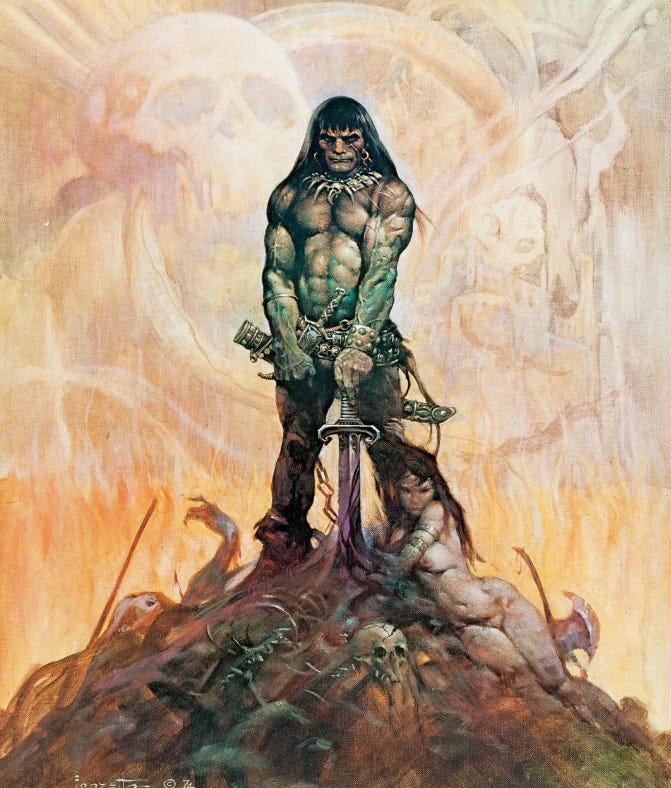
(Image - Conan The Adventurer cover art by Frank Frazetta.)
Thanks for reading! (On to part 2!!)
PS. The term ‘barbarian’ originates in the ancient Greek as ‘someone who does not speak Greek’.
Links of Note:
Note! There is more about this project here. The direct chat for this project is here. You can comment here or find me on BlueSky.
Also note! This book project is a personal one and not affiliated with any company that, in my day job, I work with or partner with.